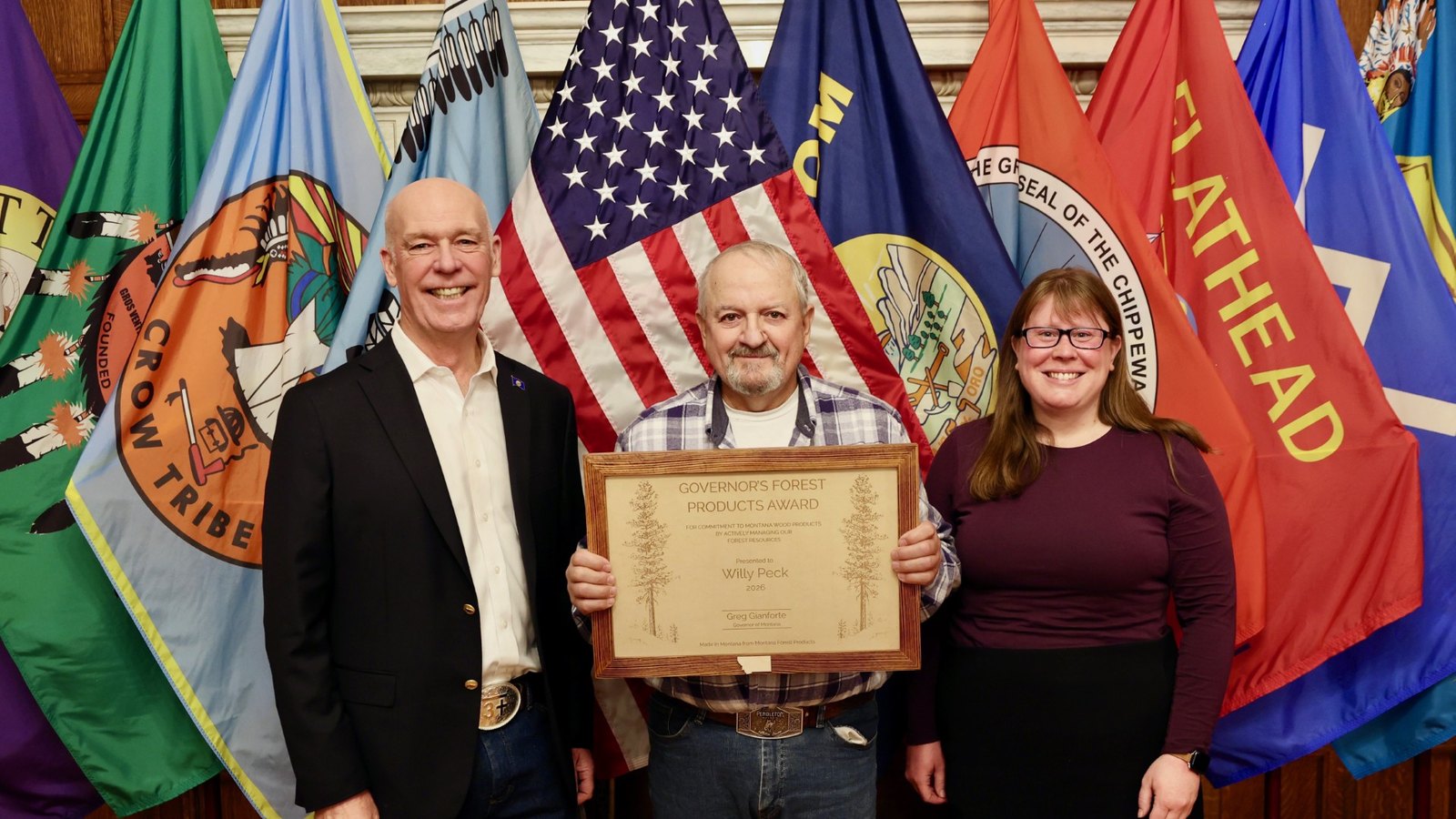
Willy Peck has spent more than half a century in Montana’s woods, and most of it in places where a timber sale can decide whether a county balances its budget. On Nov. 10, Gov. Greg Gianforte gave the Superior forester the 2026 Governor’s Forest Products Award at a ceremony in the State Capitol.
The award goes each year to a person or group that has worked to actively manage Montana forests, develop forest resources responsibly and promote Montana wood products. The governor’s office announcement credits Peck with more than five decades in the industry, starting in 1972, and says he has worked in nearly every part of it: logging, milling, resource management and outreach.
Peck didn’t take much of the credit when he accepted. “I’m honored, I can’t tell you what this means to me,” he said. “There are so many people in this group right here that have helped me. Nothing I got done, I got done by myself. Everything I did, I had Forest Service partners, I had state partners, and most of all, industry partners, to help me.”
Gianforte presented the plaque alongside Amanda Kaster, director of the Montana Department of Natural Resources and Conservation. “His hands-on experience and ability to bring agencies, counties, and industry partners together have made him a trusted leader in advancing forest management across western Montana,” the governor said.
Advisor to three counties
These days Peck works as a natural resource advisor for Mineral, Powell and Sanders counties. DNRC lists him as Mineral County’s resource advisor, the person who reads federal forest plans, writes comments and sits at the table when the Forest Service designs a project. He also co-chairs the Mineral County Resource Coalition, a group that has met monthly for more than a decade to push for forest work that helps both the land and the local economy.
That economic piece is the heart of it in Mineral County. Carol Young, Peck’s co-chair, told the coalition last year that only 7% of the county’s land pays property taxes, according to the Valley Press/Mineral Independent. The rest is mostly national forest, which leaves the county leaning on federal payments and on timber work to support jobs and services.
The county also lost its last lumber mill several years ago. “Having lost our last (lumber) mill a few years ago took the wind out of our sails, but hopefully we’ll get that wind back,” Peck told the same meeting, as reported by the Mineral Independent. At that meeting, members noted Mineral County was getting about 99 cents an acre in federal Payment in Lieu of Taxes for its national forest land, while Missoula and Ravalli counties each got more than $3. Peck’s answer was to make better use of the Good Neighbor Authority.
Good Neighbor, salvage and the Lolo
The governor’s office pointed to three areas of Peck’s work:
- Good Neighbor Authority. The program lets the state plan and run timber and restoration work on federal land. Montana has leaned on it heavily, and the state recently widened a similar partnership with the BLM.
- Post-fire salvage. Peck helped push salvage logging after the Sunrise Fire, which burned near Superior, so burned timber could reach mills before it lost its value.
- Shared stewardship on the Lolo. He helped build the state’s newest Shared Stewardship Project, on the Lolo National Forest, where state and federal agencies agree on priority areas and pool their work.
The release also credits him with giving local communities a stronger voice in federal forest planning and with helping keep a steady timber supply flowing to Montana mills.
Getting federal timber to market is rarely simple. In September 2025, Mineral County said it would file a brief backing the Forest Service after an environmental group challenged the Red Bull II timber sale near Superior, the Mineral Independent reported. Salvage after fires faces its own clock, as the Flathead National Forest’s Skillet Fire proposal shows.
Peck’s award comes as Montana tries to speed up federal permits, including through the state’s new FAST-41 agreement. For a forester who has worked the woods since 1972, much of that work still comes down to the same thing he described at the Capitol: finding enough partners to get a project done.
The Mineral County Resource Coalition meets the second Tuesday of each month in the county commissioners’ conference room in Superior. More profiles are in our Newsmakers section.
Add The Montana Statesman as a preferred source on Google (opens in a new tab)