
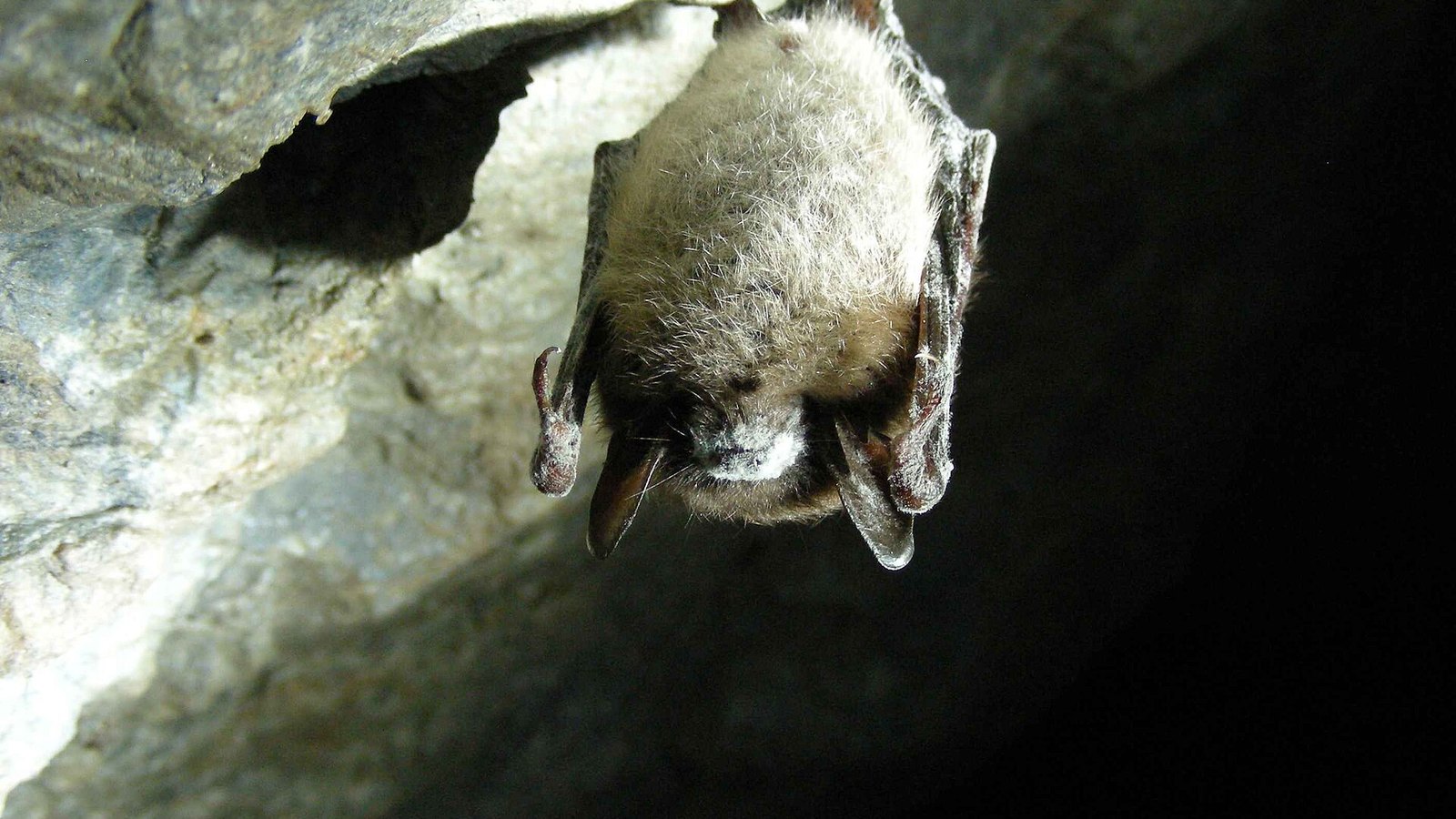

A fungal disease that has killed millions of bats across North America has now been confirmed inside Glacier National Park, the park announced last week.
According to the National Park Service, a little brown bat was found dead in the Saint Mary area on the park’s east side in May. Environmental samples collected in the same area in June then tested positive for Pseudogymnoascus destructans, the fungus that causes white-nose syndrome. The park said the finding is the first detection of the disease in Glacier and the first in Glacier County.
The diagnosis did not come out of nowhere. Park biologists have monitored bats in Glacier since 2011, and the park is home to 10 bat species. Not all of them are equally at risk. According to the Daily Inter Lake, four of those 10 species are susceptible to the disease, and three others can carry the fungus without developing symptoms.
How the disease kills
White-nose syndrome takes its name from the fuzzy white growth that appears on the muzzles and wings of infected bats. The fungus thrives in the cold, damp conditions of caves and other hibernation sites. Infected bats wake up too often during the winter, burn through the fat reserves they need to survive until spring, and many die before insects return.
Since it was first documented in New York in 2006, the disease has spread west across the continent and killed millions of bats. The Park Service said it has now been confirmed in 42 states and nine Canadian provinces. Infected hibernation sites often see population drops of more than 90 percent.
Montana has already seen what that looks like. In 2020 the disease was documented at Azure Cave in eastern Montana, the largest known bat hibernation site west of the Mississippi River. Within a few years, a roost of about 1,700 bats had dwindled to roughly 40 little brown bats, the Daily Inter Lake reported. Closer to Glacier, Montana Fish, Wildlife and Parks found the fungus near Libby Dam in Lincoln County in 2025, according to the Daily Inter Lake.
Little brown bats, the species found dead near Saint Mary, have been among the hardest hit in the East, where some colonies collapsed within a few winters of the fungus arriving.
A vaccine trial already underway
Park biologist Lisa Bate has spent about 15 years documenting Glacier’s bats and building a baseline of what a healthy population looks like. In 2024 she began field testing a first-of-its-kind oral vaccine against the disease on the park’s east side, working with the U.S. Geological Survey’s National Wildlife Health Center.
Her team has captured and microchipped 529 little brown bats in the Saint Mary area. Roughly half received the vaccine and half a placebo, and the team scans bat houses for the microchip signals to track which bats survive. Bate told the Daily Inter Lake that Glacier is especially useful as a study site because it is one of the few places where the vaccine went in ahead of the fungus.
The work has extended beyond the park. This summer, state and federal biologists gave the same oral vaccine to about 900 little brown and Yuma myotis bats living in bat houses near Libby Dam, where state monitoring had found signs of the fungus a year earlier.
Results from vaccine work take time, because researchers need to follow marked bats through at least one hibernation season to see who survives. Still, the trials give wildlife managers in northwest Montana something more than surveillance to work with now that the disease has arrived.
No risk to people or pets, but visitors can help
The Park Service stressed that white-nose syndrome is not known to pose a risk to humans, pets or livestock. The concern is for bats, and for the insect control they provide. All of Montana’s bats eat insects, and Montana Fish, Wildlife and Parks has estimated that their pest control is worth about $680 million a year to farmers and other Montanans.
People can, however, move the fungus from place to place on their gear. Spores cling to clothing, boots and equipment, especially after time in caves or abandoned mines. The park asked visitors to follow decontamination guidance, which in practice means not wearing clothing or using equipment in Glacier that has been in caves or mines elsewhere unless it has been cleaned according to the national protocol.
The usual rules for bats apply as well. Do not touch or handle a bat, alive or dead. A bat on the ground in daylight or one that appears sick should be reported to park staff or, outside the park, to Montana Fish, Wildlife and Parks. Bats can carry other diseases and parasites, so any bite or direct contact should be checked by a doctor. A dead bat found outdoors in winter may be a sign of white-nose syndrome and is worth reporting.
What comes next in the park
Glacier staff will keep monitoring bat populations and roost sites, with a closer look at the Saint Mary area where the dead bat was found. Because bats from the east side can travel between summer roosts and winter hibernation sites that may be some distance apart, biologists will be watching for signs of the disease elsewhere in the park over the coming winters.
For a park better known for grizzlies and mountain goats, bats rarely make the news. The detection near Saint Mary is a reminder that some of Glacier’s most important residents only come out after dark, and that their numbers can drop quickly once this fungus takes hold.
The park’s announcement and details on the decontamination protocol are posted on the Glacier National Park website.